

Estimated reading time: 16 minutes
There is a particular kind of launch post-mortem I’ve sat through more times than I’d like to admit.
The creator has just finished a promo.
The numbers are meh.
The list got fatigued, the conversion rate was half of what they hoped for, and somewhere around day four of the cart they stopped opening their own analytics because it hurt too much to look.
So what happened? It looks likey they did all the right things… Good offer, nice copy, emails written by a copywriter…
When we trace it back — and I mean really trace it back, past the subject lines and the sales page headlines and the webinar hooks — the failure almost never lives in the execution.
It lives upstream, in an assumption the creator made months earlier, when they decided what to build, how to position it, and what problem it would solve.
The problem was that they guessed the offer based on what they felt their audience wanted, what they saw other creators launching, what they themselves found interesting to teach. And then they built an entire launch on top of that guess and hoped the market would validate it in real time, during the cart, when it’s the most expensive possible moment to find out you were wrong.
This blog post aims to help you solve one of the biggest, most costly mistakes in selling courses.
You should read it you just came off a launch that underperformed and you’re trying to understand what actually happened.
You should also read it if you’re planning your next launch and want to de-risk it before you pour three months of your life into building, filming, and selling something.
After 6 years and more than $20M generated with email marketing, I can tell you that this is a step most creators skip because they either don’t know about it OR it sounds too boring and slow . But it’s the step that separates launches that sell like hot cakes from launches you have to force down your list’s throat.
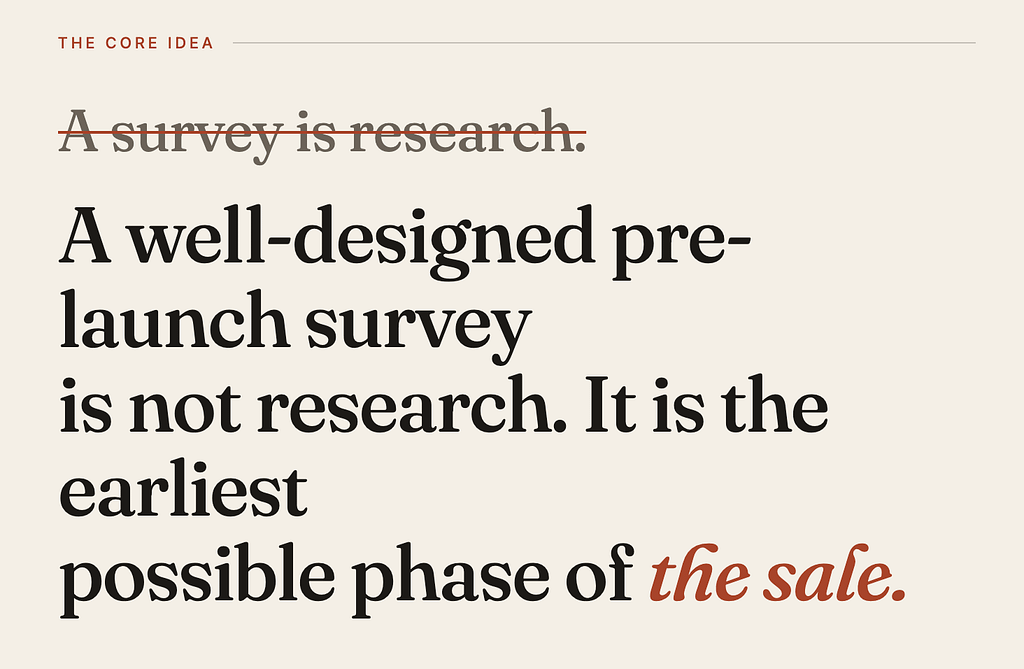
Table of contents
- When we trace it back — and I mean really trace it back, past the subject lines and the sales page headlines and the webinar hooks — the failure almost never lives in the execution.
- This blog post aims to help you solve one of the biggest, most costly mistakes in selling courses.
- This step is customer research.
- First of all, know that a survey is not research, but a pre-sale conversation.
- Three kinds of surveys, and when each one earns its place
- Segment your audience, or the data will mislead you
- The questions that actually produce usable answers
- One structural note: keep the survey short.
- Where to host it
- The email that gets the survey filled in
- How to analyze the data without drowning in it
- Surveys warm your list before you launch
- If you’ve made it this far, you already know what I’m going to say.
This step is customer research.
Specifically, a pre-launch survey.
I’ll teach you how, so keep reading.
First of all, know that a survey is not research, but a pre-sale conversation.
Yes, a survey is a form of market research. You use it to gather data points but it’s so much more than just that. It’s a very strategic asset of working with your email list and validating assumptions.
In fact, it’s the earliest possible phase of the sale. It is the moment your subscriber first articulates — to you and, more importantly, to themselves — what they’re struggling with, what they’ve already tried, and what they wish were different.
Done well, that experience can be the first clear definition of the problems and desires they have. And before anyone can buy from you, they have to become problem-aware and solution-aware. That’s what the survey does very early in your selling game.
Think about what happens in the subscriber’s head when they answer a thoughtful question like “what have you tried to solve this problem, and what didn’t work?”
They’re giving you data, but they’re also reconnecting with the problem, going back into the emotional state of what it’s like to live with it. They’re reminded they’re looking for a solution too. And by the time they hit submit on that survey, they are significantly closer to being ready to buy than they were five minutes earlier — and they did that work themselves, which means they own the conclusion.
Then there’s also this:
A survey that asks “tell me about yourself so I can make better things for you” makes people feel seen by the creators they follow. A thoughtful survey is one of the clearest signals you can send that you’re paying attention.
Three kinds of surveys, and when each one earns its place
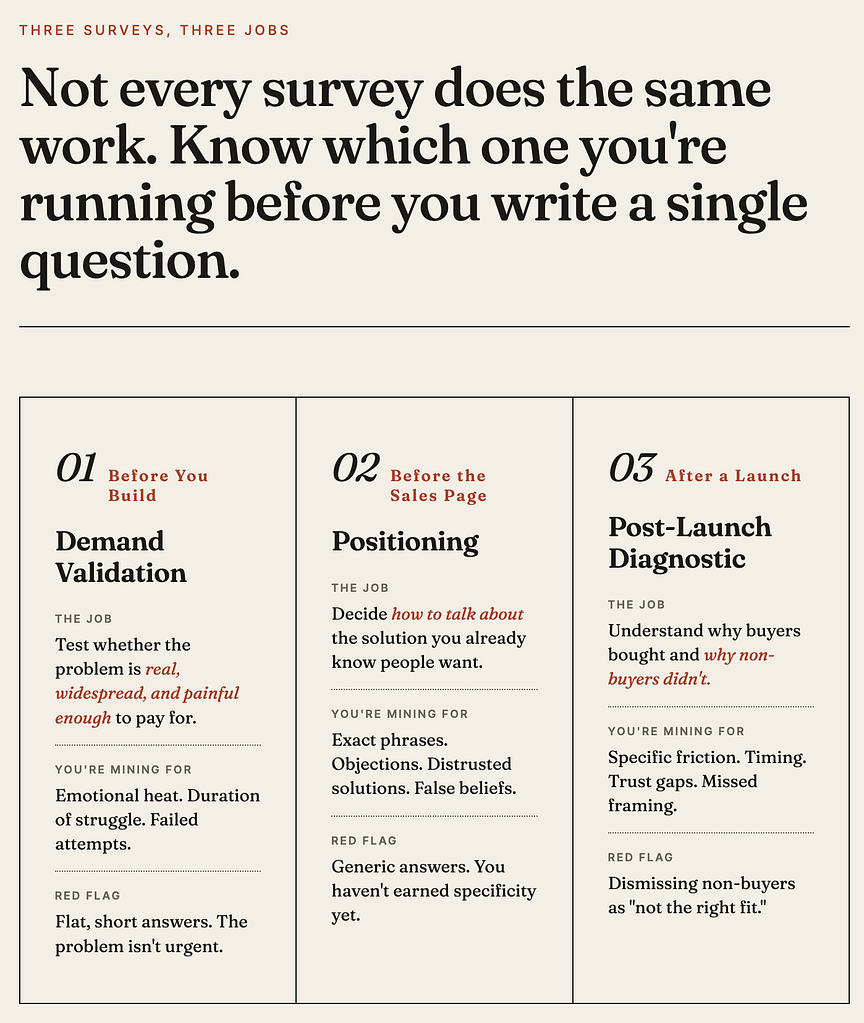
Before you prompt your favorite AI tool, it’s important to know that not every survey does the same job. You’ll want to be clear about what you’re trying to find out with a survey because that influences the questions, audience segmentation, and the analysis. I see creators blur these constantly, and the result is usually a long survey that tries to do everything and ends up doing nothing well.
1. The demand validation survey
This one runs before you’ve committed to building anything. The goal is to figure out whether a problem is real, widespread, and painful enough that your audience would pay to solve it. You’re not testing positioning yet, instead you’re testing whether the underlying demand exists at all.
This is the survey that saves you from spending six months building a course nobody asked for.
The questions here stay close to the problem itself.
You want to know: what are they struggling with right now in this area, how long have they been struggling with it, what have they already tried, where did those attempts fall short, and what would it mean for them if this problem were solved.
You’re looking for emotional heat, so if the answers come back flat and short, that’s a sign the problem isn’t urgent enough to build around — regardless of how interesting it might be to teach.
2. The positioning survey
This one runs after you’ve validated the problem but before you’ve written the sales page. You know people want a solution; now you need to figure out how to talk about yours. This is where you test language, framing, angles, and the specific false beliefs that might be standing between your subscriber and a purchase.
You’re asking about language directly — what would they call this problem if they were describing it to a friend, what solutions have they heard of that they don’t trust and why, what would make them skeptical of a course on this topic, what would make them feel confident in one.
You’re looking for the exact phrases and objections you need to address in your sales assets.
When a sales page feels like it was written by someone inside the reader’s head, it’s almost always because the copywriter ran a positioning survey first.
3. The post-launch diagnostic survey
This one runs after a launch that underperformed, and it’s the one most creators don’t do because it’s emotionally hard to ask people why they didn’t buy.
You send two different versions: one to buyers, one to non-buyers.
- From buyers, you want to understand what tipped them — benefit, objection tackling, bonus, timing?
- From non-buyers, you want to understand the specific friction that kept them out. Was it price, timing, fit, trust, or something you never saw coming?
The data from a diagnostic survey aims to explain the launch that just happened and the insights will inform the next one.
Almost every meaningful improvement I’ve seen clients make between launch one and launch two has come from taking the non-buyer feedback seriously instead of dismissing it as “they just weren’t the right fit.”
Segment your audience, or the data will mislead you
This strategy will fail when you send one survey to everyone on the list and analyze the responses as a single pool.
It might feels efficient, but it is not.
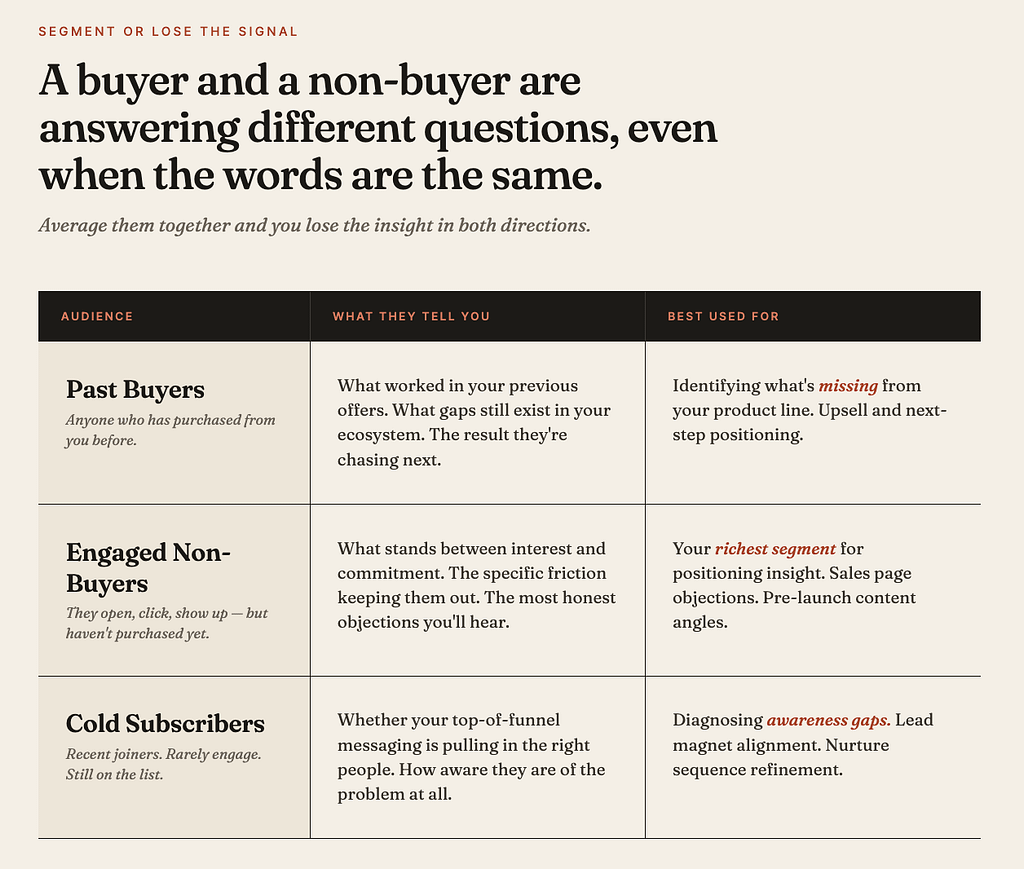
A buyer and a non-buyer are answering fundamentally different questions, even when the words on the survey are the same, because their relationship with you is different.
If you average their answers together, you lose the signal in both directions.
When you’re running a pre-launch survey — demand validation or positioning — you want to segment at minimum into three groups.
- Past buyers of any of your offers.
- Engaged non-buyers, meaning people who open, click, show up to webinars, but haven’t purchased yet.
- And cold-ish subscribers who joined recently or who rarely engage.
Each of these groups is telling you something different.
- Buyers tell you what worked and what might be missing from your ecosystem.
- Engaged non-buyers tell you what’s standing between interest and commitment — this is usually your richest segment for positioning insight.
- Cold subscribers tell you about awareness and whether your top-of-funnel messaging is pulling in the right people at all.
For a diagnostic survey after a launch, the segmentation is simpler and more obvious: buyers, cart abandoners if you can identify them, and people who watched the launch but never started a checkout.
Three audiences, three sets of questions, three different stories to listen for.
The questions that actually produce usable answers
When I write or review survey questions and find questions such as “How interested would you be in a course about X?” I immediately remove them.
Why? Well this seems like it’s testing for demand but, interest doesn’t predict behavior. Trust me, I learned this the hard way. So often, you’ll get survey responses that indicate there’s strong demand for something, the creator builds it, and then it flops.
What you want are questions that surface specific language, struggles, history with the problem, and all the possible objections.
Use open-ended to collect customer language (and psychographics data) and multiple choice for segmentation.
For a demand validation survey, the questions I return to most often are some version of these.
- What is the single biggest challenge you’re facing right now with [topic]?
- How long have you been dealing with this?
- What have you tried, and why didn’t it fully work?
- If you could wave a wand and have this solved six months from now, what would your life look like different?
- What’s stopping you from solving it right now?
Notice that none of these mention your course, or asking them to validate your idea. You’re asking them to describe their reality, and the reality will tell you whether your idea has a home in it.
For a positioning survey, the questions tilt toward language and objection.
- When you describe this problem to yourself, what words do you use?
- Have you considered buying a course, coach, or program to solve this?
- If yes, what’s made you hesitate?
- If no, what would need to be true for you to consider it?
- What’s the most frustrating piece of advice you’ve been given about this?
- What do you wish someone would just tell you honestly?
These questions are gold for sales copy because subscribers hand you the exact phrases to use and the exact objections to dismantle.
For a diagnostic survey to non-buyers, be honest about what you’re asking.
Something like: I’m trying to understand how to serve people on my list better, and I’d really value your honest feedback.
Then:
- When you saw the reminders for , what was your first reaction?
- Was there a specific moment or message where you decided this wasn’t for you right now?
- If you could change one thing about how I presented this, what would it be?
- Is there something you wish I’d offered instead?
Yes, it’s direct, it feels icky, but if you pretend you’re just curious, people will give you surface answers
One structural note: keep the survey short.
Five to seven questions for a pre-launch, maybe three to five for a diagnostic.
Every additional question cuts your completion rate roughly in half past a certain point.
The longest surveys I’ve seen produce the thinnest data because only the most compliant subscribers finish them, and those aren’t the subscribers you need to hear from most.
Where to host it
The tool question comes up in almost every conversation I have about this, so let me give you my actual working view instead of the usual “it depends.”
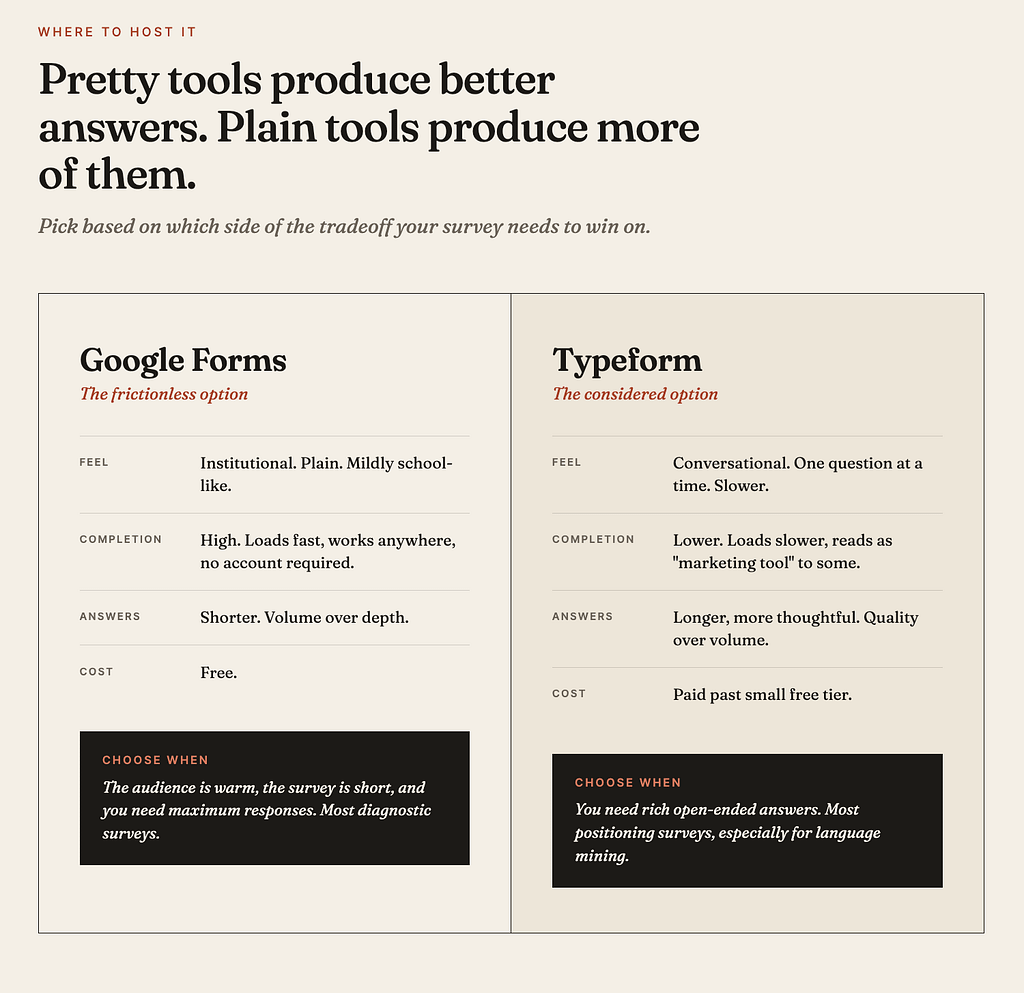
Google Forms is free, frictionless, and fine.
It will not win any design awards, and the experience of filling one in is mildly institutional — it feels like filling out a school form, but the completion rates are solid because it loads fast, works on every device, and doesn’t ask anyone to create an account.
For a diagnostic survey sent to a warm audience that already trusts you, Google Forms is almost always the right call. The lower friction beats the prettier interface.
Typeform is the prettier option.
It shows one question at a time, feels more conversational, and on balance it produces more thoughtful open-ended answers because the format slows people down.
It’s a better fit for a positioning survey where you’re mining for quality of language rather than volume of responses.
The tradeoffs: it’s paid past a small free tier, it loads more slowly on mobile, and a small but real percentage of your list will bounce out of it simply because it looks like a marketing tool.
If your list is sensitive to that kind of thing — some audiences very much are — factor it in.
A third option
if you use ConvertKit, Kit, ActiveCampaign, or similar, most have native survey or form blocks that sit inside an email or on a landing page.
These tend to be clunkier in terms of analysis but better in terms of integration — responses get tagged directly onto subscriber records, which is useful if you want to segment future emails based on how people answered.
For a demand validation survey where you intend to follow up with the engaged respondents individually, native integration can be worth the uglier interface.
The email that gets the survey filled in
The email matters more than the survey itself, because if the email doesn’t do its job, the survey never gets seen.
Most survey invitation emails fail for the same reason: they ask the subscriber to do something for the creator without making it clear what the subscriber gets in return.
The fix is simple: make the ask small, the reason human, and the benefit to the subscriber genuinely real.
Here’s a template you can adapt.
Adjust the specifics to your niche, but keep the structure.
Subject line options:
— A quick question (if you have two minutes)
— Can I ask you something?
— I want to build something that actually helps. Can you help me figure out what?
Body:
Hi [First Name],
I’m in the early stages of putting together something new, and before I build anything, I want to make sure I’m actually solving the right problem for the right people.
That’s where you come in.
I’ve put together a short survey — five questions, takes about three minutes — to understand what you’re actually struggling with right now when it comes to [topic / transformation your audience cares about].
Your answers will shape what I build next. I mean it directly.
button: [Yup, I’ll help]
How to analyze the data without drowning in it
If you’ve done this right, you’ll end up with somewhere between fifty and several hundred responses, depending on list size.
That’s enough to see patterns but not enough to run statistics, and that’s fine — you’re not writing a research paper.
Here’s the approach I use, and it’s simple enough that you don’t need any tool beyond a spreadsheet and a highlighter.
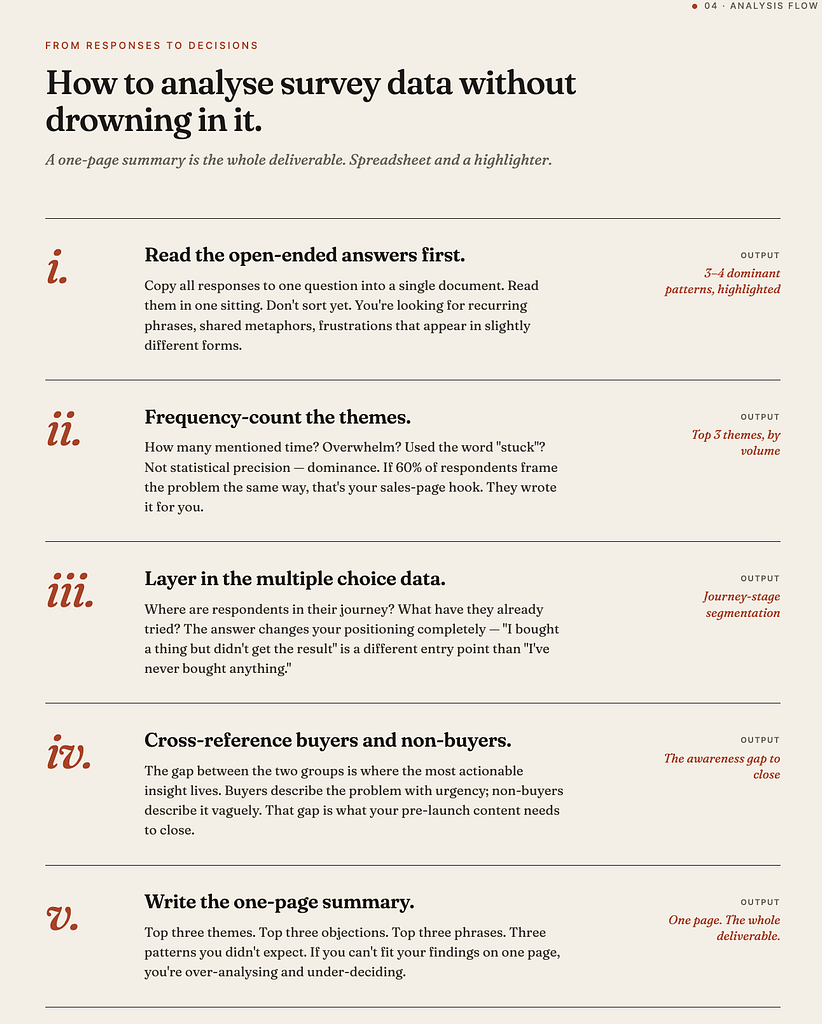
- Start with the open-ended answers, not the multiple choice.
This is the step most creators skip because it takes longer, and it’s also the step that produces every meaningful insight. Copy all the answers to a single question into one document and read them in one sitting, don’t sort yet, just read.
You’re looking for recurring phrases — the exact words people use to describe the problem, the same metaphors coming up in different answers, frustrations appearing in slightly different forms. Highlight those and by the time you’ve read a hundred answers to one question, three or four patterns will have surfaced hard enough that you couldn’t miss them if you tried.
Of course, you can use AI to do this, but I’d still read through all of those answers first.
2. Then do a simple frequency count.
How many people mentioned time? How many mentioned feeling overwhelmed? How many used the word “stuck”? You’re not trying to be precise but to see which themes dominate. If sixty percent of your respondents describe the problem using some version of the same emotional frame, that’s your sales page hook, your webinar title or your email subject line. They wrote it for you. Definitely use AI for this step.
3. Then layer in the multiple choice data for segmentation.
Where are your most engaged respondents in their journey? What have most of them already tried? If a large chunk say they’ve already bought a course on this topic and it didn’t work, that’s critical positioning information — your offer needs to address the gap between “I bought a thing” and “I got the result.” If most say they’ve never bought anything and don’t know where to start, your positioning is completely different.
4. Cross-reference buyer answers with non-buyer answers when you can.
The differences between these two groups are often where the most actionable insights live. Buyers might describe the problem with urgency and specificity; non-buyers often describe it more vaguely. That gap, vague awareness versus specific awareness, is usually what a good pre-launch content sequence is designed to close.
5. Finally, resist the urge to build a dashboard.
I’ve watched creators spend more time organizing survey data than acting on it. A one-page summary is enough.
Surveys warm your list before you launch
There’s a second-order effect of running a pre-launch survey that almost nobody talks about, and it’s arguably the most valuable part of the whole exercise.
The people who fill in your survey are self-selecting as your most engaged subscribers.
They’ve just spent three to five minutes thinking about the exact problem your upcoming offer solves and articulated their struggle in their own words, re-activated their desire for a solution.
When you eventually launch, these respondents are your warmest possible audience.
They’re already problem-aware and many of them are already aware that you are the person paying attention to this problem, because they just watched you ask about it. You also don’t need to convince them the problem matters, becauee they told you it mattered.
If you’ve made it this far, you already know what I’m going to say.
The creators who consistently launch into demand, who write sales pages that feel uncannily well-aimed, who build small lists that convert better than large ones — they almost always do some version of this.
The alternative — guessing, building, and hoping — has a failure rate that nobody wants to put in a case study.
You don’t need to do all three types of surveys at once.
Start with one: if you’re in the planning phase of your next launch, run a demand validation survey in the next two weeks and see what comes back.
If you just came off a launch that underperformed, send a diagnostic survey to your non-buyers this week while the experience is still fresh in their memory.
Don’t wait until you feel ready to design the perfect one, even a short, warm, specific survey sent on a Tuesday afternoon will outperform a brilliant survey that never gets sent.
The goal was never to know everything about your audience before you launch but to stop guessing about what you build, how you say it, and who it’s for.