

Using testimonials in emails can be an effective way to build trust and credibility with your subscribers and drive conversions.
Here are some tips on how to use testimonials in emails:
-
Choose relevant testimonials: Make sure the testimonials you use in your emails are relevant to the content of the email and the product or service you are promoting.
-
Highlight specific benefits: Use testimonials that highlight specific benefits or results that your subscribers can expect from your product or service.
-
Include social proof: Make sure the testimonials include the name and photo of the person providing the testimonial, as well as any relevant credentials that can increase credibility.
-
Use visuals: Consider using visuals, such as images or videos, to showcase the testimonials and make them more engaging for your subscribers.
-
Use them strategically: Use testimonials strategically in your emails, such as in the subject line, header, or call-to-action.
Here are some examples of how to use testimonials in emails:
-
Use a testimonial in the subject line to grab your subscriber’s attention: “Discover How Sarah Increased Her Email Open Rates by 50%”
-
Use a testimonial in the header or subheader to highlight specific benefits: “Learn How to Build a Profitable Online Business – As Seen on CNN Money”
-
Use a testimonial in the body of the email (or PS) to build credibility: “See What Our Customers are Saying About Our Product” and include a few relevant testimonials.
-
Use a testimonial in the call-to-action to encourage conversions: “Join Thousands of Satisfied Customers – Start Your Free Trial Today!”
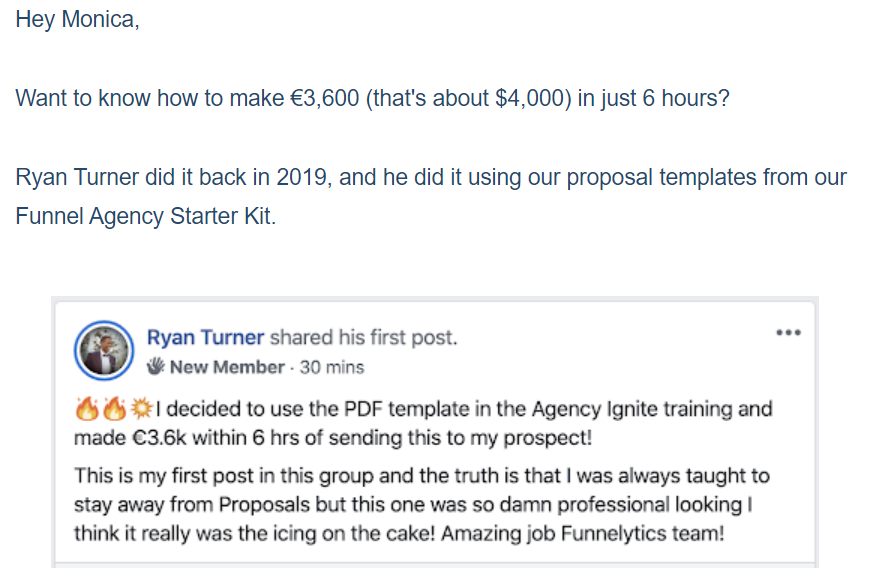


Overall, using testimonials in emails can be a powerful way to build trust and credibility with your subscribers and drive conversions.
By choosing relevant testimonials, highlighting specific benefits, including social proof, using visuals, and using them strategically, you can maximize the impact of testimonials in your email marketing campaigns.
Want to learn more about using testimonials to promote your course? Here’s what to read next:
-
Black Friday Offers: Give Buyers a Reason Beyond Price
A Black Friday discount tells someone what they could save. It doesn’t explain whether your course addresses the problem they’re facing, whether they’re ready for it, or why it deserves a place in their budget. That distinction becomes especially important when every other email is advertising a sale. Your subscriber might be considering your course…
-
Case Study: Is Your Email Marketing Just a Pile of Sequences?
Every course creator realizes this at some point: you have a lot of emails. A welcome sequence, a launch sequence, a webinar follow-up, some kind of evergreen thing that runs in the background. Each one was probably written with real thought and yet, revenue still is unpredictable and it depends more on which promotion you…
-
Case Study: We Built a $97 “Impulse Buy” Instead of the $17 One Everyone Recommends
One of my coaching clients was making real money, but almost all of it came from live webinars. If he wasn’t actively running one, the business slowed to a crawl. “If I weren’t doing a live webinar, I would be broke,” he told me on one of our calls. The webinar worked, but it just…
-
Email Marketing for Course Creators and Digital Product Sellers: The Answers to the Questions You’re Asking
A long-form guide by Monica Badiu — covering list growth, deliverability, launch strategy, monetisation, and the ethical frameworks behind emails that actually convert. Most course creators I work with come to me with what they think is an email marketing problem, but underneath it is almost always something else — a positioning question, a customer-understanding…
-
Case Study: What 10+ A/B Tests Reveal About Abandoned Cart Emails for an Online Course Business
Most abandoned cart optimization advice is written for ecommerce: physical products, product images, discount codes, urgency timers. The playbook is well-worn and mostly borrowed from retail. So it’s no surprise course creators don’t think this tactic applies to them, and for good reason: course businesses are different, and so are the objections and the psychology…
-
Case Study: $12,000 a Year From One Email Nobody Thought to Write
Most course creators don’t think abandoned cart emails are for them and after working with 100+ creators all over the world, I can tell you that a very small percentage are actually employing this tactic. It’s a missed opportunity and I’ll tell you more in a future case study. But let’s look at what happens…