

Black Friday is coming and if you’ve ever been through a Q4 campaign (whether you were running ads, managing email sequences, or doing both simultaneously) you already know that the preparation and the execution are two completely different beasts.
You can have the best strategy in the world and still fall apart when the dashboard starts moving in the wrong direction at 11pm on a Tuesday because the problem with Q4 isn’t just tactical. It’s physiological.
I had this conversation recently with Rita Ainsworth, a performance marketing veteran who managed ad budgets of up to $70,000 a day before burning out twice and walking away at the peak of her career. What she discovered on the other side completely changed how she approaches Q4 and the way she now weaves ad strategy together with nervous system management is one of the most practical things I’ve heard in years.
Here’s what came out of that conversation.
Q4 Is a Different Game Entirely
If you’ve never run paid ads during Black Friday, the first thing you need to understand is that the environment changes dramatically, and not in your favour. Rita shared a number that stopped me in my tracks: for one of her clients last year, CPMs (the cost per thousand impressions on Meta) sat at around $60 in September. By Black Friday, that same metric had climbed to $9,500.
That’s not a typo.
The reason is simple: every advertiser on the planet, from the biggest e-commerce brands to solo course creators, is targeting the same audiences at the same time. Your ideal customer, let’s say a 35-year-old woman interested in professional development, is simultaneously being targeted by supplement brands, fashion retailers, jewellery companies, and every other course creator in your niche. She has a fixed pot of money to spend. Everyone is competing for a share of it.
Which means that during Q4, offer positioning and emotional resonance matter more than ad budget. The course creator who wins isn’t necessarily the one spending the most, but the one who can articulate the transformation most clearly and make their offer feel more important to that specific person than anything else on their list.
The Single Most Important Thing You Can Do Right Now
Rita’s answer to almost every Q4 question comes back to the same starting point: start earlier than you think you need to. Most course creators begin preparing for Black Friday in October. Rita (and increasingly, the data) suggests September is already late.
Here’s why. The majority of Black Friday sales happen through retargeting (not cold audiences or brand new subscribers), but people who have already seen your content, visited your pages, engaged with your emails, or watched your videos.
Which means the email list you’re building right now, the organic content you’re publishing right now, the lead generation campaigns you’re running right now, all of it is the infrastructure your Black Friday campaign will run on. If you wait until November to start thinking about this, you’re starting the race without having warmed up.
Rita’s recommendation for course creators who want to run ads in Q4 is to start a lead generation campaign well before the season — ideally with a tripwire offer behind it, so the leads you’re generating are demonstrably high-quality and the campaign is at least partially self-funding. By the time Black Friday arrives, you’ll have a larger email list, warmer retargeting audiences, and enough data to know what’s actually resonating before the pressure is on.
Did you know 80% of your Black Friday revenue
gets locked in by end of September?
Watch the Plan Now, Profit Later workshop and walk away with:
The 3 non-negotiable decisions to make in September and why missing even one leaves you stuck with desperate discounts.
Where to look for clues to inform this year’s success (the signals are already in your data… if you know how to read them).
How to avoid the November scramble: the difference between creators who guess and those who execute a proven plan.
Know Your Numbers Before You Need Them
One of the most practical things Rita shared is the concept of leading indicators versus lagging indicators — and why understanding the difference is what keeps you from making emotional decisions in the middle of a campaign.
Lagging indicators are the numbers most people watch: sales, revenue, return on ad spend. The problem with these is that they show up late. There’s a lag between someone clicking an ad, visiting a sales page, going to checkout, and completing a purchase — and there’s a further lag in how platforms report that data. Which means on day one of your Black Friday campaign, your revenue numbers are going to look wrong. Not because the campaign is failing. Because the data hasn’t caught up yet.
Leading indicators are the numbers that tell you whether the campaign is on track before the sales show up: click-through rate, cost per landing page view, cost per add to cart. If you know what those numbers look like in a healthy campaign — based on your past data or industry benchmarks — you’ll know whether to hold steady or pivot without having to make that call based on panic.
Rita’s advice: build a spreadsheet. Know your benchmarks going in. And when day one looks alarming, check the leading indicators before you change anything.
The Skill Nobody Teaches: Managing Your Nervous System During a Live Campaign
Rita spent over a decade in performance marketing. She managed international teams, oversaw accounts spending tens of thousands of dollars a day, and worked across time zones that meant there was always someone, somewhere, who was working, which meant she felt like she always should be too.
The first burnout ended dramatically. She was checking an account she was spending $50,000 to $70,000 a day on, and her brain simply stopped computing. She could see the numbers but she couldn’t understand what they meant. A metal band of pressure across her forehead. Months of not being able to work more than two hours a day. Months of not being able to watch a screen.
The second burnout followed because she returned to the same pre-burnout state without understanding what had caused the first one.
What she knows now, and what she teaches the founders, operators, and marketers she works with, is that the nervous system state you’re in shapes every decision you make. A regulated nervous system makes better marketing calls than an exhausted, adrenaline-driven one. And the problem for most high performers is that they’ve learned to use stress as fuel — coffee, sugar, urgency — without realising that every time they do, they’re borrowing energy they’ll eventually have to repay.
What Functional Burnout Actually Looks Like
Most course creators aren’t going to hit the dramatic wall Rita describes, but many of them (maybe most) are living in what she calls functional burnout: tired but functioning, using stimulants to generate adrenaline, perpetually hovering just below the line of collapse.
The signs: you wake up tired, you need coffee before you can think, you reach for sugar when the stress peaks. You can’t switch off at the end of the day and you’re making decisions from a place of depletion rather than clarity, and you don’t always know it, because you’re still technically functional.
The cost of operating in this state during Q4 shows up in the decisions you make. Whether you panic and change a campaign that was actually working, or misread data because your brain is too tired to think clearly.
Three Practical Tools for Staying Regulated Through Q4
Rita’s recommendations are deliberately simple. Because when you’re in the middle of a high-pressure campaign, you don’t have time for complex protocols.
One: magnesium.
If you’re not taking any supplements, start here. Magnesium supports the nervous system, supports energy production, and is involved in hundreds of processes in the body, many of which get depleted under chronic stress. Rita calls it a foundational supplement for anyone heading into Q4. High quality is important so look for magnesium glycinate or magnesium malate rather than the cheaper oxide form.
Two: the 4-6 breath.
Breathe in for four counts. Breathe out for six. Do ten rounds. That’s it.
The extended exhale activates the parasympathetic nervous system aka your body’s rest-and-digest state, as opposed to fight-or-flight. Even one minute of this practice can shift you out of a reactive, hyperactivated state and back into one where you can actually think. Rita recommends doing this every time you feel yourself tensing, spiralling, or looping on a problem.
Three: communicate before the campaign starts.
This one sounds simple and gets ignored constantly. If you’re running a business and you’re heading into your most demanding season, the people around you need to know what’s coming: your team, your family, your partner because misaligned expectations are their own source of stress, and you don’t need that layered on top of everything else.
Rita’s suggestion: let people know in advance that November is going to be intense, and plan something for after to look forward to on the other side that signals this is temporary.
Why the Offer Is Still Everything
Whatever the nervous system state, whatever the ad budget, whatever the strategy, Q4 comes down to one thing: how well you know your audience, and how clearly you can articulate why your offer matters to them specifically.
Rita framed it this way: your ideal customer has a fixed pot of money and a mental list of things she wants to buy. Your course is competing with luxury items she’s been waiting to afford, with gifts for her family, with everything else she’s been tracking since summer. The question your campaign has to answer in the ad creative, in the email, in the sales page copy, is why your course matters more to who she’s trying to become than anything else on that list.
That’s not a budget question but a positioning question and it’s one you can answer regardless of how much you’re spending.
When I look back at my own Q4 history, the years that nearly broke me were the years I started late.
Rushing assets, juggling multiple deliverables and segments at the same time, feeling like I couldn’t stop to take a breath and then spending the first two weeks of December in a fog, unable to think about Christmas gifts because my brain had simply run out of capacity.
The year everything changed was the year we started in September. We had time to test demand for specific offers, to implement tools like heat maps and collect data, time to research, to segment, to iterate. And for the first time in years, I actually bought something for myself during Black Friday weekend, which sounds like a small thing, but felt like proof that the season didn’t have to be something you just survive.
If you’re reading this and want to be prepared for Black Friday, here’s where to start:
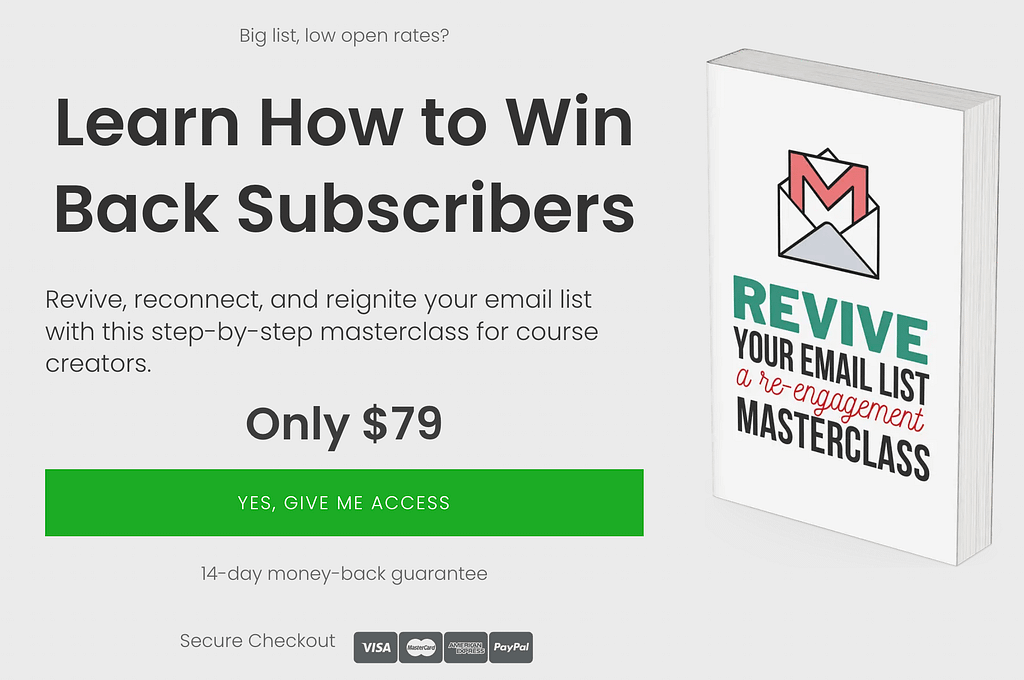
Look at your email list. How many inactive subscribers do you have? Run a re-engagement campaign before the season, not during it. Warm contacts convert at a completely different rate than cold ones.
Look at your past data. What offers worked last year? What resonated? What fell flat? Spend time with this before you build anything new.
Start your lead generation now. Even a simple campaign with a tripwire offer behind it starts building the warm audiences you’ll need in November.
Take Rita’s quiz. Before anything else, know where your nervous system actually is right now, because everything else depends on that.
And if you want to go deeper on everything Rita and I covered, the ad strategy, the nervous system science, the real story of what two burnouts taught her about performance and doing less, listen to the full episode of Master The Inbox.
If you’d rather not guess your way through Black Friday this year, check out the Black Friday Playbook for Course Creators. It has everything: the exact strategy to implement, the templates and even the swipe files to help you strategize and implement without guesswork and the last minute overwhelm.
***
Listen to Master The Inbox
This is the podcast for course creators, coaches and consultants who want to know how to use email marketing to nurture and convert their audience in a non-spammy, non-bullshit BUT data driven approach. See all episodes right here.
Other links:
- Free Email Revenue Assessment: https://www.monicabadiu.com/email-revenue-self-assessment/
- Join the Skool community for course creators interested in email marketing https://www.skool.com/master-the-inbox-school-4845/about
- Learn more about email marketing on YouTube: https://www.youtube.com/@mastertheinbox
- Follow Master The Inbox on Instagram: https://www.instagram.com/mastertheinbox_
- Learn more about running successful email promos: https://www.youtube.com/playlist?list=PLmXZEZDMnLQf1GnQeRfO5nUjNtZwEzoi0
- Visit Monica’s website: https://www.monicabadiu.com
- Follow Monica on LinkedIn: https://www.linkedin.com/in/monicabadiu/
Want to learn email copywriting?
Start by analyzing what others are doing. My Email Teardown series showcases some of the best (and sometimes worst) examples of sales emails that have hit my inbox. Here’s the link to the playlist. I publish new email reviews every week.